
Remembering Sekou & Me
Snapshots of the artists as a young black man.

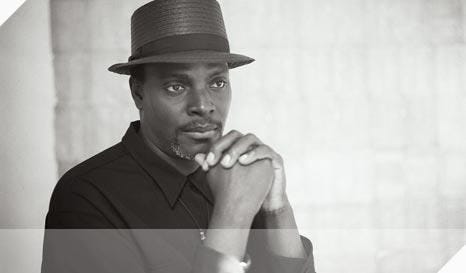
As the year comes to a close, I have been asked to assess some of my best writing from the year. I’m a bit surprised to find myself paying attention to the stats. Very strange. At any rate, one of my favorites was my republishing of Farewell to a Dream of Baldwin, in which I thought about the sort of black artists and writers who would appreciate my work, including the triumvirate of Marsalis, Crouch and Murray. Thinking of them made me think of New York and my favorite black artists of that time - but one name I couldn’t remember. So I did a manhunt with ChatGPT and it found Sekou Sundiata, exactly who I was looking for.
It turns out I have some other stuff I wrote which I’m sure hasn’t seen the light of day in over 20 years. So here goes, originally from The Well’s autobiographical forum.
Dateline 3Q1992
Journal - Third Quarter, Nineteen Ninety Two
As I was explaining to homeboy over my speakerphone, Terry McMillan could not have happened 20 years ago. Perhaps I am mistaken, certainly there were black writers getting published with talent and vision equal to that of Ms. McMillan, but the readership this time has changed. NYT bestseller list only requires so much, and now the hungry black public is all that. It seems to me that the age of Spike Lee, Public Enemy, Arsenio Hall and Terry McMillan is upon us. Media, unquestionably has been forced open to the willing black public. We are in there, marginally of course, creating a new style of media star - super star status of performers created by black populist movement forcing itself upon the private worlds of American publishing. The professional exploiters, working for bottom line capitalists remain the master manipulators. The opportunity soon comes for political counter revolution within the establishment as only the perversely otherworldly black stars can do as they ply their magic on the bottom lines of these businesses.
White liberals have been replaced by black liberals. Inspired by personal experience, they broker the terms of this experience into political rhetoric and press demands upon whatever establishments there be more or less regularly.
----
There once was an ancient monastery to which the faithful peasants flocked weekly to confess their sins. The monks, having heard the confessions took upon themselves the burden of the people and forgave them. They would then retire to the monastery and whip themselves on their own backs for the sins of the peasants. One monk, however would always only flog his feet. His screams were the loudest. One day the head monk asked him, brother why do you flog your feet so? To which the monk replied. They itch goddammit! Draw your own moral, or make it a dirty joke through ad hoc replacement of feet.
----
These days I am reading histories. Joan Didion, Howard Zinn, Gore Vidal. What is to become of me? It is almost unbearable to recount the cruel nature of American slavery, indentured servitude and the repressive laws of Virginia’s House of Burgesses. The traveling down the path of history for the sake of perspective almost narrows it. There are so many examples of rebellions whose resonance begs repetition in these cruel times. But what sort of students of history should we be? Should mind zinging parallels be drawn? To whose benefit accrues the knowledge history - whose unknown slant we come to know only through repetitive backwards journeys - provides? The very act of reading about the past to draw wisdom forces acknowledgement of my bourgeois isolation. I face the Ibo’s dilemma without the advantage of capable nobility. Should I write or should I act? Should I breathe life through my words or through my loins? Which is wasted seed?
Dateline April 1997
19970428.1700
Several years ago I read Darryl Pinckney’s ‘high cotton’ and found a big chunk of myself. Never having succumbed totally to the quaint form of madness we call writing, I kept my day job. Nevertheless, in my diary, now spanning about 15 years, I kept watch over my soul in a way no god was supposed to care. Though I had never been born into that world where other such sentinels marked the passage of time by the influences of influences and the reading of souls, I took a great deal of comfort knowing there were those out there with the same types of measuring sticks. In ‘high cotton’ I could see another me, soul to soul. Sometimes in literary passages, I nurtured a self found in asymmetric real places, often named ‘black’, sometimes called ‘intellectual’, mostly clumsily evoked, and in those glimmering moments I would leap to call such a writer a friend. But it has always been deeper than mere friendship and the souls never met. With the rhythm it takes to dance to what we have to live through you could dance underwater and not get wet - my troupe I called my existential partners. Darryl Pinckney, Hinton Als, Paul Beatty, Sekou Sundiata, Greg Tate gathered - a circle in my head joining hands across time with Jean Toomer and others unknown - to form an imaginary band. In the context of that music, my voice never seemed too far out of tune.
Living in New York had its downside. Opportunities presented themselves to meet a real face, a real body. The dismemberment of persons touched in a reality based context forced a reconciliation of sorts. And Cornel dropped from the fairy ring, and Charles Wright fell from supernal grace, and Lisa Jones became an ordinary woman, and Harlem became a forgotten, dirty urban village.
Yet my predominating hopes, fed by the reality of my pedestrian day job’s distance from the clang of literary looms, allowed the sweet music of existential harmonizing to continue unabated. Until I got married and moved to Atlanta, after which nothing of the sort mattered one whit. I instantly became old-school and was finally able for the first time in my life, to look forward to beer and television. I cannot explain the miracle tantamount to childbirth in women that gives men such Neanderthal focus. Perhaps it is fear, life’s most comforting fear, the fear of losing ones family. So for several years, I have been thankful for my day job and tossed the sublime subtleties of literary soul cultivation to the dreadhead poets collectives of Fort Greene and other alternative universes.
Just this weekend, having returned home to a lightning fried modem from a sales retreat in Florida, I decided to cut down on my online time. What writing I have done to satisfy that impossible urge has been spent in lowercase missives to the masses on the vague values of anti-racist politics over the Internets more or less public domains. I have found in Cornel West’s and the rest of the crew’s interactive default, ample space to carry on dozens of conversations and diatribes worthy of aspiring pillars of the Continuing Renaissance. But it was about time for that to come to a close. It may as well be now. So I invented a new project - that of transcribing my written diaries into Microsoft Word. If Spaulding Grey can get away with it, so can I. Who knows, maybe this new media might turn up something worthwhile after all. So, I arbitrarily found myself in the fourth quarter of 1991, suffering some pain long forgotten in the current context of diapers.
Shaping the web is a nightmarish task, especially when ones existential partners default. Reading the web remains interesting. So today, at my day job, I picked up a slate, electronically of course. Whats this? Pinckney? Naw, it couldn’t be. Oxford, England? It must be.
So now the fate of the diarist is serendipitously tossed into the air. Just as I thought closure was possible, now I have yet another reason to mark the ether and phlogiston for a while and gauge the measures of souls in cyberspace. What weight will fit on the narrow bytes from the fingers - the brown fingers on the white keys pounding away in that crazy attempt to express the depths of humanity from yet another abstracted distance? Then again, cyberspace is close. Very close.