
Blacks Against Sanctuary Cities
Snitching against criminals.

17 years ago, I was much more involved in politics, conservative politics to be sure. But then, as now, I didn’t do so in order to be controversial or confrontational. It’s just that like many of my black American peers, the American Right was such a mysterious unknown country, we couldn’t be sure exactly whom we were agreeing with when those moment of agreement occurred. I have come to recognized the difference and the distance between black ideas and black politics, the former being a great deal broader than the latter. It was that gap, among other things that had me join the Right.
I was just reviewing some of my old video when I came across these two, which not ironically have some resonance today.
Detail: https://notegpt.io/share/99a00b4b2
Abstract: The video discusses the complexities surrounding Special Order 40, Jamiel’s Law, and immigration enforcement in Los Angeles. Special Order 40, established in 1979 by former LAPD Chief Daryl Gates, prohibits LAPD officers from initiating investigations solely based on a person’s immigration status. The intent was to encourage cooperation between immigrant communities and law enforcement by separating local policing from federal immigration enforcement. However, Jameel’s Law advocates for rescinding Special Order 40 after the tragic killing of Jamiel Shaw, an all-star football player, by a Mexican national gang member recently released from jail. The video explores the broader systemic issues, including jurisdictional challenges between local police forces, the role of gangs with transnational ties, and the limitations of the criminal justice and immigration systems working in tandem. Programs like 287(g), which deputize local law enforcement to assist in immigration enforcement, reflect attempts to bridge these gaps but also generate concerns about civil rights and due process. The speaker stresses the need for better systemic coordination, tighter controls on dangerous criminals, and thoughtful legislative reform to address these intertwined public safety and immigration challenges.
This one, I recorded around the same time, and it certainly goes to the question of whether or not communities are or are not determined to disagree with police. #PublicNullification
Detail: https://notegpt.io/share/ca58a1208
Abstract: The video presents a reflective and nuanced discussion surrounding the Sean Bell case, focusing on the complexities of police tactics, community expectations, and the unfortunate circumstances that led to a tragic incident. The speaker, drawing on insights from Professor Spence and personal observations, explores the standards by which police actions are judged, particularly in high-risk environments like strip clubs operating late at night. The incident occurred at 4 a.m. in a Queens strip club during an undercover police operation involving multiple officers. A confrontation escalated when someone threatened to retrieve a gun, culminating in the victim running over an undercover officer with a car. The speaker emphasizes that while the chaotic and dangerous setting does not justify the loss of life, it helps explain how the situation spiraled out of control.
The video delves into the legal perspective of what constitutes “reasonable” police behavior, highlighting the difference between a judge’s viewpoint of what a “reasonable police officer” would do versus a layperson’s understanding of what a “reasonable person” might expect. This distinction is critical in judicial decisions but complicates public perception, especially when racial and community dynamics influence expectations and interpretations of police action. The speaker also reflects on the societal and community failures that allow such dangerous establishments to operate, questioning why the community does not take more responsibility for shutting them down and why police must intervene in such hostile environments. Ultimately, the video is a meditation on the intersecting responsibilities of police, citizens, and the justice system in preventing tragedies and maintaining order in difficult, morally ambiguous circumstances.
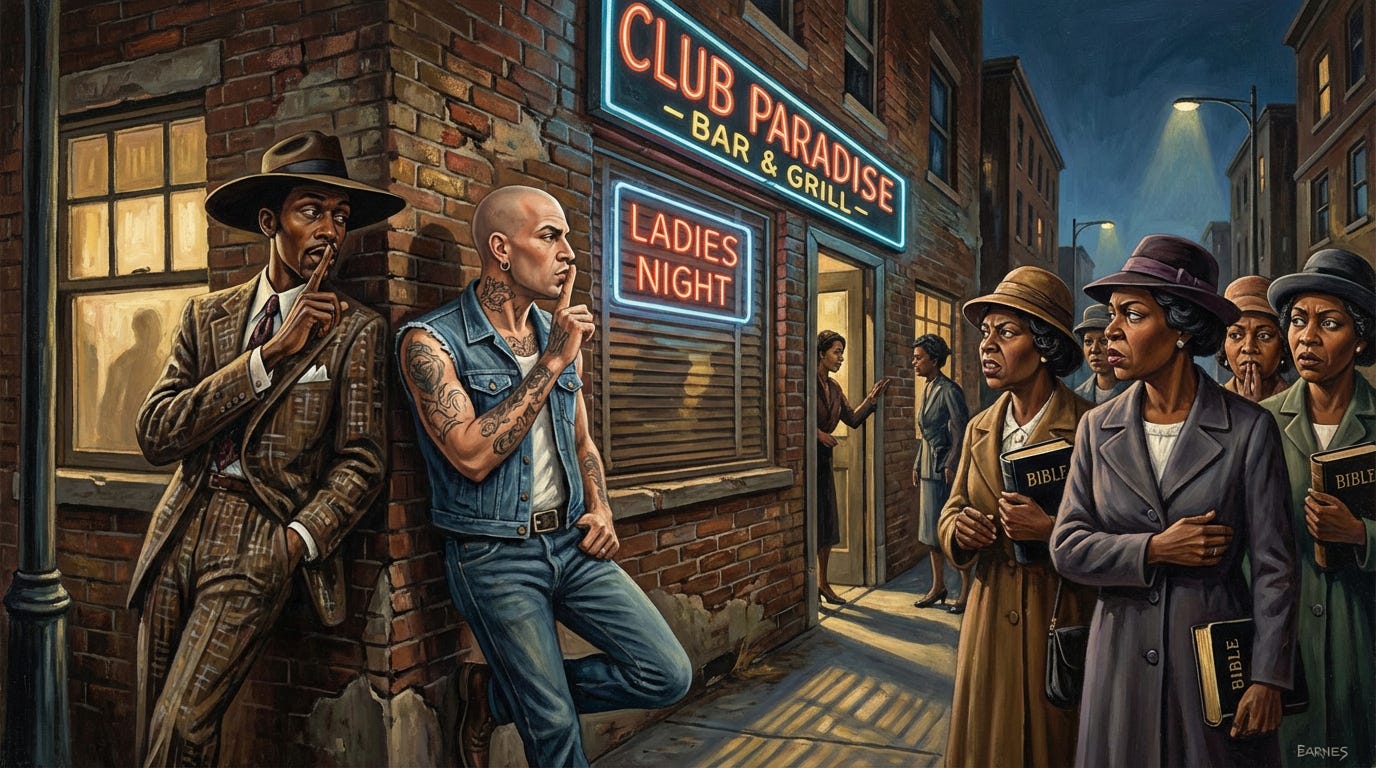
Like many people I was outraged when a predictable chorus of activists against the ‘Prison Industrial Complex’ weighed in against the execution of Tookie Williams, leader of the Crips in Southern California who was convicted of four counts of murder. We should always remember that there are people who will use arguments and political or racial solidarity and victimization to excuse legitimate acts of justice. Such a minority cannot and should not be silenced, but their existence and persistence shows that the public, especially a postmodernist sand populists can not always expect justice to be served.
Seventeen years later, I still have to make the same arguments. Any city government that decides that the criminal element has the right to continue to ply their trades is no different from those of the Jim Crow South or Dodge City, Kansas. Sanctuary is the job of churches, not of the state.